Back in September 2010, Paul Graham published his original post on High Resolution Fundraising. That starting point — and specifically the idea that startups should be able to offer different prices to different investors, a.k.a., “high resolution fundraising” — led to Y Combinator’s eventual unveiling of the original SAFE in 2013.
The simple agreement for future equity fit a clear need in the fundraising market, and over the next several years became an industry standard. But if we look back at Graham’s original essay, it’s clear that the SAFE (while a major step forward) doesn’t manage to fulfill the true potential of what PG thought startup financing should be.
Enter the ****Rolling SAFE: a legal template that lets founders raise money continuously, across the whole life of their company up until an IPO. The Rolling SAFE allows investors to invest in a company at any time, with the valuation increasing automatically as more funds are raised, benefitting investors who move quickly.
Why do we at Fairmint see the Rolling SAFE as the natural next step in the evolution of financing? Graham’s essay can make the case for us.
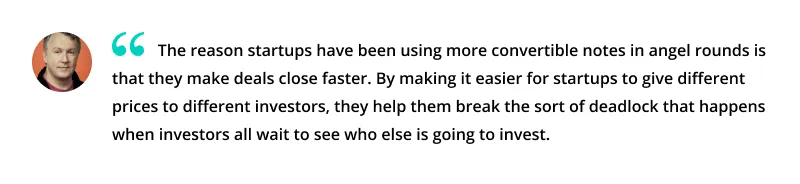
The issue is clear: investors don’t really like risk. And there’s nothing more risky than being the first one to put money into a startup. And so over time investors developed ways of working that privilege social proof, waiting for someone else to put in money first and de-risk the whole venture.
The problem is that this slows founders down, big time. Graham notes that this is a reason to privilege high resolution fundraising, so that the people who come in early are rewarded with significant benefits in terms of price (rather than a fixed round where any investors who get in will enjoy the same price, regardless of who said “Yes” first).
The Rolling SAFE turns this up to 11. Everyone is able to see the price today and decide whether or not they want in. The key is that an investor knows that waiting can now have a real cost — at any moment, someone else can come along and invest, driving the price significantly higher and capturing the upside before you.

This is exactly what the Rolling SAFE allows for, with the benefit of being a single, ongoing agreement. No need for multiple notes, no need for multiple SAFEs: just one rolling fundraising to rule them all.
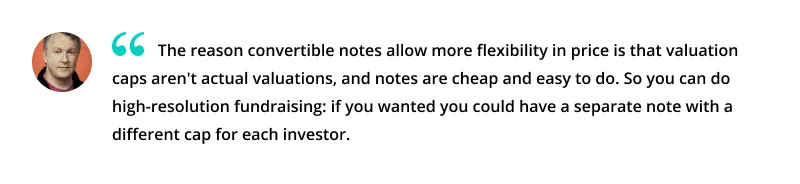
Even if notes are cheap and easy to do, even if the original SAFE became the same, they’re still individual moments that the founder has to deal with. As such, no one ever really arrived at the point where they were offering a separate note with a different cap for each investor. The beauty of the Rolling SAFE is that it can do precisely that, without the hassle of drawing up new contracts each time.

Just because the Rolling SAFE is designed to be “set it and forget it”, founders stay in control — meaning that if an investor comes along who can really change the game, founders can negotiate and eventually add more equity into their offering, letting them reward investors who they believe will deliver outsized amounts of assistance.

This is the key.
The SAFE took convertible notes and evolved toward higher resolution. The Rolling SAFE is doing that again, confirming Graham’s observation that markets always evolve toward higher resolution.
Graham’s correct that it is a mistake to try to settle upon a specific number. Founders have wasted way too many hours trying to invent reasons for why they’re raising $3M instead of $2.5M, when the simple fact is that they don’t know, investors don’t know, nobody knows how much capital a startup actually needs.
The Rolling SAFE starts from that fact and doesn’t even try to predict what will happen across the company’s lifespan. If the founders execute and the company grows, they will be able to use that progress to get more investments from more people. The amount one can fundraise with a Rolling SAFE is linked to business momentum, not a number drawn out of a hat for a pitch deck.

Exactly! But with a Rolling SAFE the amount raised also depends on the business’s fundamentals. And while these may not be able to be predicted, they can be directly influenced by company’s founders and team.
Maybe. But does it really make sense for a Series A? After all, the same “who else is investing” deadlock that Graham talked about with very early rounds still exists in the Series A world today. VC funds will absolutely tell founders that they want to invest in the Series A or B, but not be the lead (and that’s not always just a roundabout way of saying “No”!). Why should founders accept that later in their business’s development, when they’ve ostensibly proven more and built a more solid company? The Rolling SAFE eliminates that issue.

Except Series A (and beyond) aren’t really high res, unless you want to restrict the benefits of startup investing to the lucky few who can get into the best deals. But why should you?
After all, a startup today is driven by a wide community: early adopters and fans, employees who truly believe in the mission, enthusiastic investors, whether professional or not… In a world where stakeholder capitalism is becoming more than just a buzzword, where the power of the community stands at the base of great startups, why not let as many people as possible financially benefit from the company’s growth?
And why should those benefits be restricted to the time period of a “round”? A company grows and changes over the course of years, even decades. There’s plenty of time to discover a great product, whether it takes 6 months or 6 years. With the ability to be at the highest possible resolution for fundraising, with every investor receiving their individual price — thanks to the Rolling SAFE — why should the party ever stop?
With the Rolling SAFE, bolder investors are rewarded with lower prices. But importantly, nobody has to be left behind — there is no more need for investors to hold onto their “Anti-Portfolio” lists. An investor can get in at any time, knowing that yes, they might be paying more than they would have a year ago, a month ago, a week ago, but that they’re in nonetheless.
The best deals? The Rolling SAFE throws them open to all. The only question is how great of a deal an investor wants to get.
Like this post? Clap 50x and share on social! Love what we’re building? Head to fairmint.com, where you can check out that “Invest Now” button 🥳