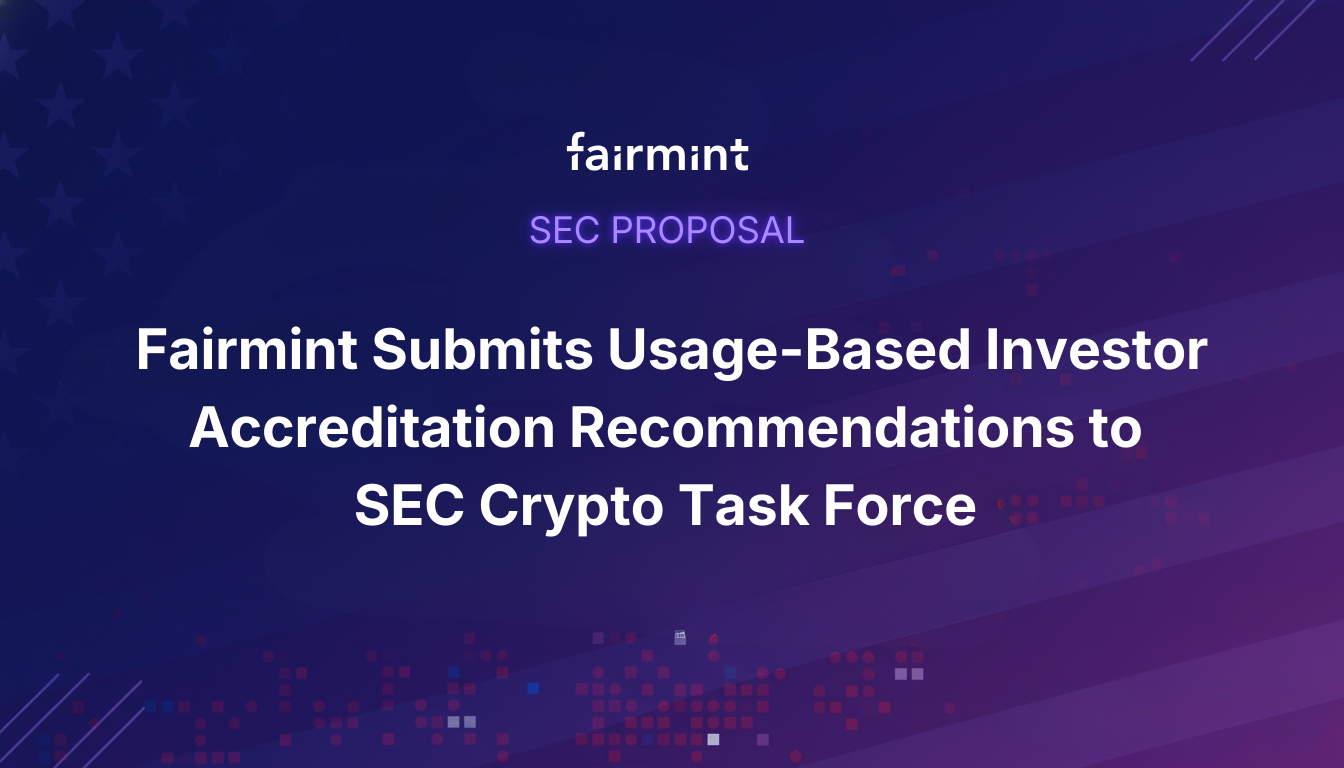
Today we submitted a proposal to the SEC’s Crypto Task Force: let people invest in private companies based on what they know and do, not just how much they earn or what they own.
Why It Matters
Since 1982, to qualify as an accredited investor you generally need $1 million in net worth or $200,000 in annual income, with a few additional thresholds. Today, these rules lock out approximately 81 percent of U.S. households from private market investment.
Former SEC Commissioner Elad Roisman pointed out in 2020 that even some securities regulators might not meet the wealth test. When the people regulating markets cannot participate in them, we are measuring the wrong thing.
The Proposal
We are advocating for two complementary paths to modernize access:
- Knowledge-based accreditation: a standardized exam demonstrating financial literacy, regardless of wealth, but more agile than the Series exams.
- Usage-based accreditation: a pathway for people to invest in specific companies where they have a verifiable, active relationship, without extending blanket accreditation to every issuer.
Qualification could be based on active product usage over a minimum period, employment status, code contributions, verified customer or commercial relationships, and demonstrated industry expertise.
In practice, that could mean a driver investing in the ride-sharing company they work for, or a developer owning equity in the project they help build. Qualification would be issuer-specific rather than universal. Smart contracts can verify these criteria and revoke access if engagement ceases.
Why Blockchain Makes This Possible
Traditional transfer-agent workflows rely on manual processes. Verifying usage-based criteria for thousands of investors simply would not scale.
Blockchain infrastructure changes that. Fairmint has processed more than $1 billion in private-company equity on blockchain rails, enabling privacy-preserving verification, pre-trade enforcement through smart contracts, and complete auditability.
As an SEC-registered transfer agent, if policymakers modernize eligibility categories, we can operationalize those criteria using both traditional and onchain data sources.
Building on Previous Work
This is our second submission to the SEC Crypto Task Force. In May 2025, we outlined how equity securities can operate compliantly on blockchain rails, covering transfer-agent recordkeeping, regulatory observability, and standardized infrastructure.
Today’s submission complements that work by addressing who should be able to access these markets. Our vision is a compliant onchain equity infrastructure that expands access to the people who know companies best.
The Market Shift
Accreditation rules do not directly regulate when a company goes public, but they materially shape how and from whom companies raise capital while private. We are witnessing a fundamental restructuring of capital markets.
Companies went public earlier in the old model. The largest IPOs in history are still ahead of us, and retail investors remain locked out until after institutional investors have captured most of the upside. Secondary-market platforms exist precisely because accredited investors need liquidity before IPOs, and companies keep experimenting with new routes to public markets.
When people building, using, and supporting companies cannot invest in them, we leave economic signal on the table. Users often understand business risk better than distant investors. Current rules assume otherwise.
What Happens Next
We have asked the SEC to advance knowledge-based examination standards, explore conditional issuer-specific accreditation, and engage with transfer agents on automated compliance infrastructure.
Read the full submission: Modernizing investor accreditation for onchain capital markets.
Read the full press release: Fairmint Submits Usage-Based Investor Accreditation Recommendations to SEC.