
Although community capitalism may seem like a new topic, humans have been striving for it for centuries. As different societal models evolved over time, each iteration has been fueled by the hope of creating a fairer and more transparent distribution of wealth. Community capitalism is the inevitable next step in this slow but steady march toward progress.
Societal models have always been defined around technological innovation. As technology became more advanced, workers’ productivity increased, reducing capital requirements and increasing market sizes.
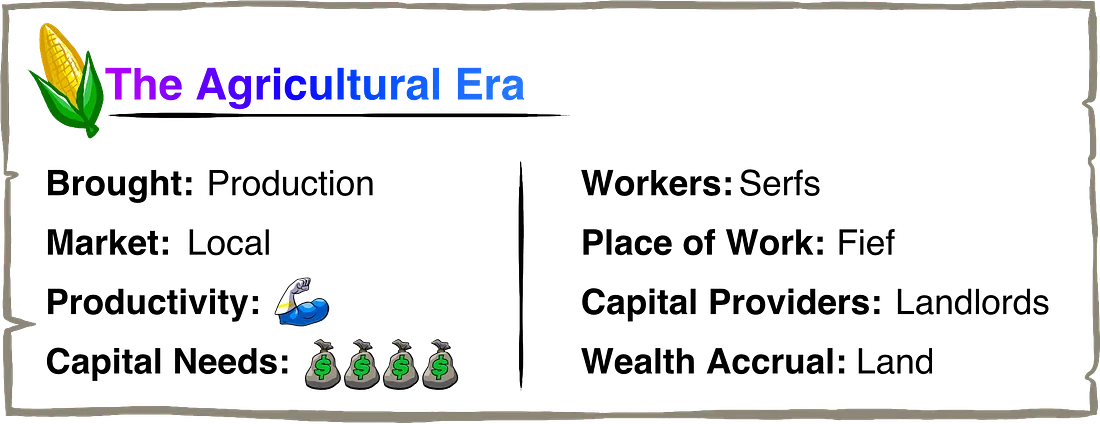
The first period of wealth inequality that spurred change on a large scale was a result of the Agricultural Era. Society was arranged into fiefdoms, in which the nobility owned the farmland and therefore the harvest. Workers got only a small portion of the harvest and were limited to their local communities, unable to travel to other towns or countries to find better opportunities.
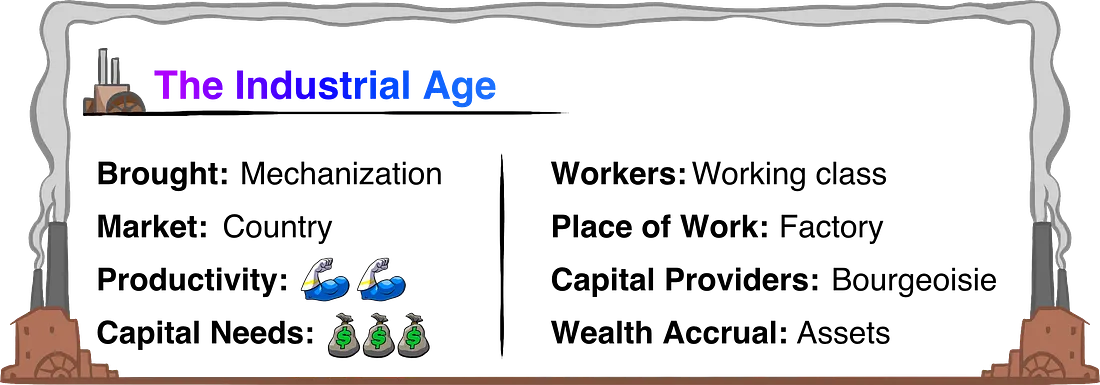
Then, the Industrial Age brought a new era of productivity. The steam engine introduced an early iteration of automation to the economy, and, with it, factories and the working class. The growing middle class accrued wealth in the form of assets like real estate. Workers moved to cities to find better work, turning those cities into cultural capitals that facilitated the exchange of ideas and in turn sped up the pace of innovation.

Electricity brought the ability to mass produce goods and store them. Wealth no longer solely belonged to those born with it — a larger group of shareholders now owned companies. The increased scale of production in turn widened the distribution of material prosperity and created a larger middle class.

Fast forward to today, when the internet has brought about the Information Era. People around the globe interact with each other 24/7, collaborating on new products and exchanging ideas. For the first time in history, the digitalization of the economy has given inventors the ability to create products that generate massive returns with minimal upfront capital, enabling anyone in the world to create significant wealth from their work.
The desire to live in an equal and humane society has always been there. Compared to the Agricultural Era 12,000 years ago, our society is now global. Our skill sets are far more vast, ranging anywhere from industrial farming to mining bitcoins. However, we couldn’t get to where we are without specific inventions being created along the way. And the tools to create a new world didn’t exist — until now.
The Information Age that we’re living in has progressively remodeled the relationship between organizations and their consumers. We can distinguish three main phases:
• Web 1.0 , the “Read” era, was a tool of consumption. Businesses, media companies, and retailers created content that was meant to be read in a one-way dialogue. Examples of these businesses are Microsoft, Yahoo, and AOL.
• Web 2.0, the “Write” era, brought about social media platforms, mobile apps, and online marketplaces that grew explosively. Unlike in the Web 1.0 era, technology now enabled people to switch from being passive consumers to active creators on the internet: writing and liking posts, uploading pictures, sharing geolocation, and so on. People became more involved in the creative aspect of online life, while they were also being productized. This era is marked by the creation of companies like Uber, AirBnb, Facebook, and Instagram that were able to generate sky-high returns on capital by harnessing the free work and resources contributed by their community.
• Web 3.0, the “Own” era, is the next evolution of the internet. Made possible by the invention of Bitcoin and decentralized cryptocurrencies, Web 3.0 is the natural reaction to the excesses created by the Web 2.0 era in terms of power and wealth centralization. People are now conscious that companies use their free work and resources to generate massive profits and influence, from which they are excluded. Web 3.0 is creating a community ownership economy that was impossible in Web 2.0.
Web 3.0 turns stakeholders into shareholders
In traditional Web 2.0, company shareholders benefit from the labor of their employees *as well as *their users. Users create and upload their own content to platforms like Facebook and Google for free. On top of that free labor, Google and Facebook sell their users’ data and attention to advertisers. It’s no wonder that companies like Google and Facebook are so rich — they are able to monetize the free work and resources provided by their users on a global scale.
In Web 2.0 companies, shareholders (like founders, investors, and employees) benefit tremendously, while non-shareholders (like users, customers, contractors, and other partners) are left out. A great example of this is Airbnb or Uber. When these community-based companies started to grow, wealth accrued only to investors, the founders, and a handful of early employees — not the drivers, hosts, and guests that actually provided the work and resources that created that wealth.
In today’s venture capitalist system, investors invest in companies that can generate outsized returns. Start-ups in this system monetize a product or service that is derived from the work and resources contributed by their community:
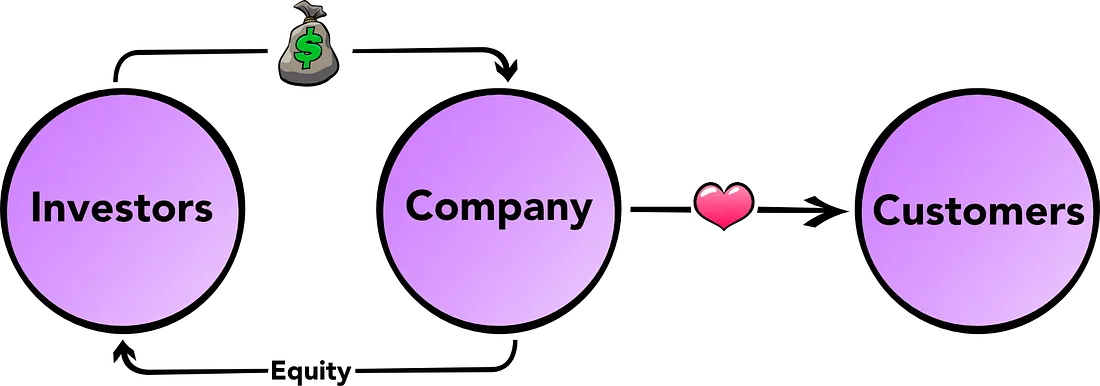
A company that needed capital to grow its business turned to investors. Investors would provide that capital in return for equity in the company, an asset that could grow substantially in value as the company grows. The community of people that fueled that growth — the contractors, customers, and partners — didn’t have access to ownership.
While Web 2.0 companies were extracting as much value as possible from their community (to the financial delight of their investors), crypto emerged and showed the world the massive potential of community capital. They started creating community-led, internet-native organizations whose value creation accrues to tokens held by that community. In this paradigm, workers and capital providers finally meet and are treated as equals, to benefit equally from the value created by organizations.
Community capitalism is the next and likely ultimate stage of capitalism. Any stakeholder of an organization who can provide relevant capital in the form of money, time, or any other valuable asset, is given the opportunity to receive its fair share of the organization’s overall financial success. It has only been made possible by the staggering increase in human productivity brought by successive transformative technologies over the past 12,000 years. Community capitalism creates the most financially aligned companies where company owners and their community all share the same interests, resulting in the most powerful feedback loop a company can have:
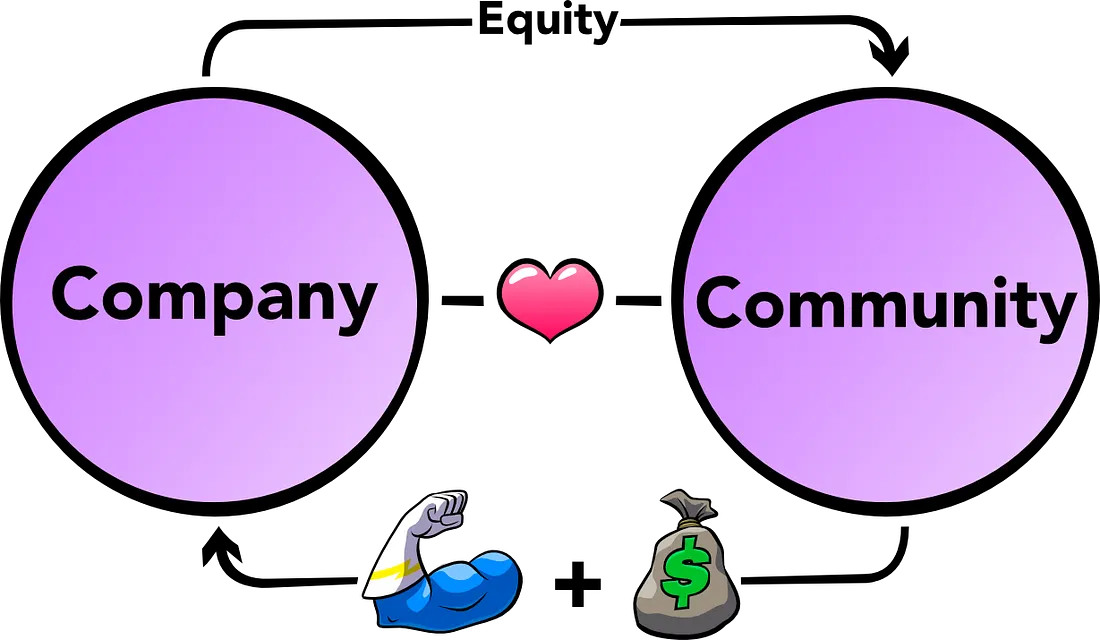
Until now, the power of community capital was restricted to native crypto projects, which pioneered and brought this new model to life. But, in a world where communities are now at the heart of value creation, community capitalism is bound to take over the world.
We’re already living in the future
We created Fairmint to give any organization the ability to tap into its community capital easily, quickly, and transparently. This paradigm not only brings financial resources, It also brings human resources and organic communication to the forefront. Community capitalism is poised to be one of the most important societal evolutions in the world. By opening up ownership in early-stage high-growth companies, community capitalism will continue humanity’s march towards a broader and fairer wealth distribution. The reality is near, and Fairmint has a seat at the head of the table.
Until now, the tools to own businesses — and therefore wealth — have been limited to the select few who are allowed inside of an exclusionary circle. However, at Fairmint we’ve been working to create a more fair society by blending the user experiences people are used to in the Web 2.0 world with the decentralized, interoperable, and fully programmable financial rails built in the Web 3.0 world. Fairmint provides businesses at all stages with the tools they need to open their equity to their community. Shareholders no longer exclusively sit in fancy firms from Wall Street or Silicon Valley. They can be from anywhere in the world, from all walks of life, with one common interest: a passion for building companies that are beneficial to its communities and the greater world. Fairmint is more than a product — it’s a movement.
The internet looks completely different than it did at the beginning. So should equity. Find out more about community capitalism at fairmint.com or reach out to us at team@fairmint.com to chat.